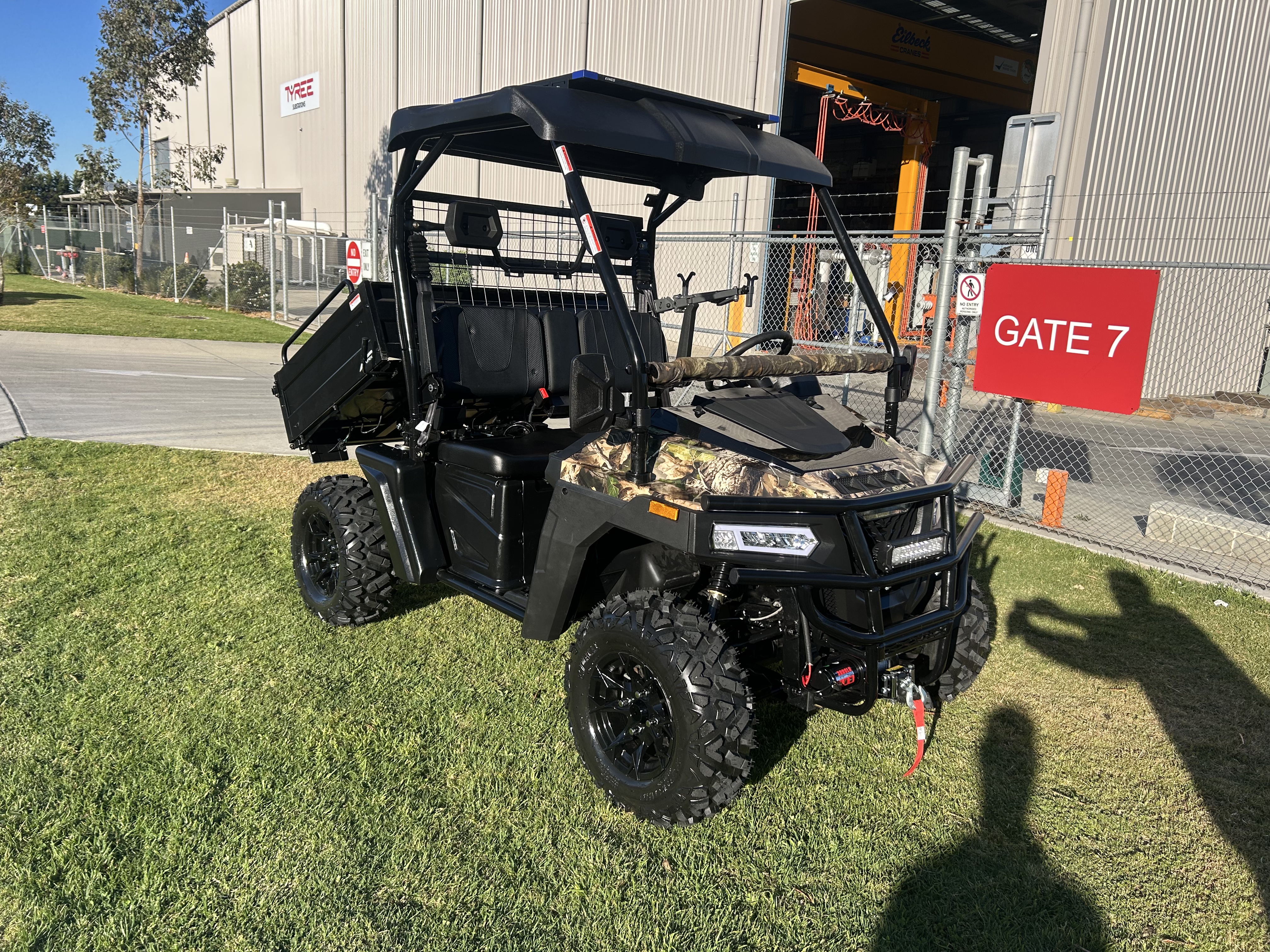
How to Get the Most from Your Hybrid UTV: Smarter Driving, Charging and Fuel Savings
A Utility Terrain Vehicle (UTV) is one of the hardest-working vehicles on many Australian farms. From checking livestock and fences to towing equipment, climbing steep paddocks and carrying supplies, it can cover a remarkable range of jobs in a single day.
But not every job requires the same amount of power.
That’s where hybrid technology offers a different approach.
The Farmtrek Terrain Hybrid UTV combines petrol and electric technology, giving operators greater flexibility in how they use their vehicle.
Understanding when to use petrol power, when to take advantage of electric operation and how to make the most of the charging system can help improve efficiency, reduce fuel consumption and make everyday farm work more economical.
Here are some practical ways to get the most from your hybrid UTV.
1. Match the Power to the Job
One of the biggest advantages of hybrid technology is the ability to use different power sources for different working conditions.
Think about a typical day on the farm.
You might start by checking livestock, travel along relatively flat tracks to inspect water troughs, climb a steep hill to reach a boundary fence and then tow equipment back towards the sheds.
Each task places different demands on the vehicle.
When petrol power makes sense
Petrol operation is particularly useful for demanding tasks such as:
- Climbing steep hills and challenging terrain
- Towing heavier loads
- Carrying substantial equipment or supplies
- Working in conditions requiring sustained power
These activities place greater demands on the drivetrain, making petrol power an important part of the Terrain Hybrid’s versatility.
When electric operation makes sense
For lighter duties, electric operation can provide an efficient alternative where conditions and the available battery charge permit.
Consider activities such as:
- Checking fences and gates
- Travelling between nearby paddocks
- Inspecting livestock and water troughs
- Moving around sheds and farm buildings
- Short journeys across relatively level ground
Using electric operation for suitable tasks can reduce the amount of time the petrol engine needs to run.
The principle is simple: use the power you need for the job you’re doing.
2. Make the Most of Regenerative Braking
The Farmtrek Terrain Hybrid incorporates regenerative energy recovery technology.
In conventional vehicles, much of the energy involved in slowing down is dissipated as heat through braking.
Regenerative systems can recover a portion of that energy and return it to the electrical system.
On a farm, where vehicles frequently slow down, stop and navigate changing terrain, opportunities for energy recovery may arise throughout the working day.
For example, travelling along a descending track may create an opportunity for regenerative energy recovery, depending on the vehicle’s operating conditions.
That recovered energy can contribute to the electrical system rather than being entirely lost.
Practical tip: Drive smoothly, anticipate stops and use the vehicle’s regenerative functionality as designed. Never rely on regeneration alone to control speed on steep descents, particularly when towing or carrying loads.
Regenerative braking does not create unlimited energy, but it can help improve overall efficiency.
3. Use Solar Charging to Your Advantage
Australian farms have one resource in considerable supply for much of the year: sunshine.
The Terrain Hybrid’s solar roof charging option provides an additional way to contribute energy to the electrical system.
While solar charging is supplementary rather than a replacement for all other charging methods, it can help make use of sunlight during the working day.
To maximise its contribution:
- Park in a sunny location where practical.
- Avoid unnecessary shading from trees and buildings.
- Keep the solar panel surface clean.
- Make use of available daylight when the vehicle is parked.
Solar output will vary according to weather, season, shading and panel orientation.
The benefit is the opportunity to capture additional energy without relying exclusively on external charging.
4. Charge Smartly, Not Just When the Battery Is Low
A hybrid vehicle is most useful when its electrical system has sufficient charge for the tasks ahead.
The Farmtrek Terrain Hybrid supports external charging, allowing operators to replenish electrical energy when a suitable charging supply is available.
A simple charging routine can make a difference.
For example, charging the vehicle after the day’s work may help ensure it is ready for lighter electric-powered duties the following morning.
If your property has solar electricity generation, arranging charging during periods of available solar production may also help reduce purchased electricity costs, depending on your energy system and tariff.
Practical tip: Consider your next day’s workload when planning charging. If you expect several short journeys and routine property inspections, having charge available gives you more opportunity to use electric operation.
Always follow the manufacturer’s charging instructions and recommended battery operating limits.
5. Reduce Unnecessary Petrol Engine Use
One of the reasons hybrid technology is attractive for agricultural applications is the potential to reduce petrol consumption.
A conventional petrol UTV relies on its engine for propulsion, even when travelling short distances or performing relatively light tasks.
With a hybrid system, some of those activities may be undertaken using electric power instead.
Consider a property where the UTV makes repeated short trips between the shed, paddocks and livestock yards.
Individually, those journeys may not consume much fuel. Across weeks and months, however, regular use adds up.
Where suitable electric operation replaces petrol-powered travel, fuel consumption and associated exhaust emissions can be reduced.
The actual savings depend on factors including:
- Distance travelled and frequency of use
- Terrain and load
- Driving behaviour
- Proportion of work completed electrically
- Battery charging patterns
- Petrol and electricity prices
There is no single fuel-saving percentage that applies to every farm.
However, making greater use of electric operation for appropriate tasks creates an opportunity to reduce petrol consumption over time.
6. Think About the Whole Working Day
Getting the most from a hybrid UTV isn’t necessarily about driving differently every minute.
It’s about considering how the vehicle is used across an entire working day.
For example:
Morning — Routine livestock checks
Begin with shorter, lighter journeys between paddocks and watering points, using electric operation where appropriate and sufficient charge is available.
Mid-morning — Heavy work
Switch to petrol power when climbing steep terrain, towing equipment or undertaking more demanding jobs.
Afternoon — Property maintenance
Use the Terrain Hybrid’s onboard 240V auxiliary power supply for compatible electrical tools or equipment when working away from the shed.
End of day — Recharge
Return the vehicle to its usual storage area and recharge as required, ready for the following day’s work.
This approach takes advantage of the different capabilities of the hybrid system without compromising the vehicle’s practical role on the farm.
7. Use Your UTV as a Mobile Power Source
The Terrain Hybrid isn’t just about how the vehicle moves.
It also incorporates a 240V, 3,000-watt auxiliary power supply, creating opportunities to use compatible electrical equipment away from fixed power points.
This can be particularly useful for:
- Charging cordless tool batteries
- Fence and gate maintenance
- Supporting suitable equipment at livestock yards
- Temporary work areas
- General property maintenance
Having electrical power available where the work is happening may reduce the need for separate equipment or additional trips back to the shed.
However, auxiliary power draws on the vehicle’s available energy. Using electrical equipment can affect the charge remaining for other hybrid functions.
Check equipment wattage, start-up demand and operating time before use.
8. Maintain Your Vehicle for Better Efficiency
Even the most advanced hybrid technology benefits from good vehicle maintenance.
Simple practices can help reduce unnecessary energy consumption and maintain performance.
Check tyre pressures
Incorrect tyre pressure can increase rolling resistance, affect handling and contribute to unnecessary energy use.
Avoid carrying unnecessary weight
Extra equipment and supplies add weight, increasing the energy required to move the vehicle.
Keep up with servicing
Regular servicing helps maintain the petrol engine, drivetrain and electrical systems in accordance with manufacturer requirements.
Drive smoothly
Unnecessary hard acceleration and braking can increase energy consumption.
Plan your trips
Combining jobs into one journey can reduce unnecessary travel across the property, regardless of whether you’re using petrol or electric power.
Small improvements in everyday operation can add up over the life of a working vehicle.
9. Understand the Potential Fuel and Emissions Benefits
Reducing petrol consumption can deliver both financial and environmental benefits.
When a hybrid UTV completes suitable journeys using electricity rather than petrol, it can reduce fuel use and tailpipe emissions during those journeys.
Over time, this may translate into lower petrol expenditure, particularly for vehicles used frequently throughout the working week.
Charging from renewable electricity, including farm solar generation, may further improve the environmental benefits.
However, overall savings and emissions reductions depend on how the vehicle is operated and where its electricity comes from.
The greatest opportunity is generally to use the electrical system effectively, rather than treating the hybrid exactly like a conventional petrol UTV.
10. Get the Balance Right
A hybrid UTV is designed to combine the practical advantages of petrol operation with the additional capabilities of electric technology.
For demanding work, petrol power remains valuable.
For lighter duties, electric operation can help reduce reliance on fuel.
Regenerative energy recovery, solar charging and external charging provide additional ways to support the electrical system.
And with onboard auxiliary power, the vehicle can contribute to jobs beyond transportation.
The result is a more flexible approach to everyday farm work.
Make Every Trip Work Harder
The Farmtrek Terrain Hybrid is designed for the varied demands of Australian rural properties.
Whether you’re checking livestock, climbing hills, towing equipment or carrying out maintenance away from the shed, understanding how to use its hybrid capabilities can help you get more from the vehicle.
It’s not about choosing petrol or electricity for every job.
It’s about using the right power, at the right time, for the right task.
Explore the Farmtrek Terrain Hybrid UTV and discover how hybrid technology can support a more efficient working day.